How to benchmark hotel performance with Loopon
Loopon helps hotels and hospitality organizations understand how their guest satisfaction and online reputation compare with other properties and competitors. By combining standardized guest feedback, performance metrics and competitive benchmarking, teams can identify strengths, recognize opportunities and make more informed decisions. This guide explains how benchmarking works in Loopon and how to use comparisons to improve guest experiences.
Understand your performance in context
Guest satisfaction scores provide valuable information about your business, but individual results do not always tell the complete story. A high satisfaction rating may indicate strong performance, but understanding how that result compares with similar hotels provides a more meaningful perspective.
Loopon allows hotels to benchmark selected performance indicators against other properties using standardized guest survey questions and online reputation data. This makes it possible to evaluate results in a broader context and understand whether performance is improving relative to the market.
By monitoring these comparisons over time, hotel managers can identify areas where their property performs particularly well and recognize where competitors may be delivering better guest experiences.
Compare hotels within your organization
For hotel chains and hospitality groups, internal benchmarking provides a structured way to understand performance across multiple properties.
Loopon supports comparisons between hotels within the same organization, helping management teams monitor guest satisfaction, evaluate differences and identify successful practices. By reviewing results across properties, organizations can better understand how service standards are being delivered and where additional attention may be needed.
For example, if one hotel consistently achieves higher satisfaction scores for breakfast or reception, its working methods may provide valuable insights for other properties. Internal benchmarking helps turn these differences into opportunities for learning and improvement.
Benchmark against your competitors
Loopon's competitive benchmarking functionality allows hotels to compare their performance against a selected group of competitors, known as a competitive set or comp set.
A competitive set consists of relevant hotels that provide a meaningful basis for comparison. Loopon uses standardized survey questions to ensure that results are comparable across participating properties. These comparisons can include Net Promoter Score (NPS), booking experience, reception, room standards, cleanliness, service and breakfast.
To protect confidentiality, survey results from competing hotels are presented as aggregated values rather than individual property scores. Competitive sets must also meet specific requirements regarding the number of participating hotels, companies and survey responses to maintain reliable comparisons.
This approach helps hotels understand their position without exposing confidential guest feedback or individual survey results from competing properties.
Monitor your online reputation
Benchmarking in Loopon also extends to online reputation, allowing hotels to compare publicly available review performance with competitors.
Through the Reputation Management section, you can monitor ratings and reviews from platforms such as Google, Booking.com and Tripadvisor. Competitive comparisons help reveal differences in online reputation, review activity and guest perceptions.
Loopon provides reputation-related performance indicators that help hotels evaluate their position within a competitive set. By reviewing these results alongside guest survey data, teams can develop a more complete understanding of how their property performs and how it is perceived by guests.
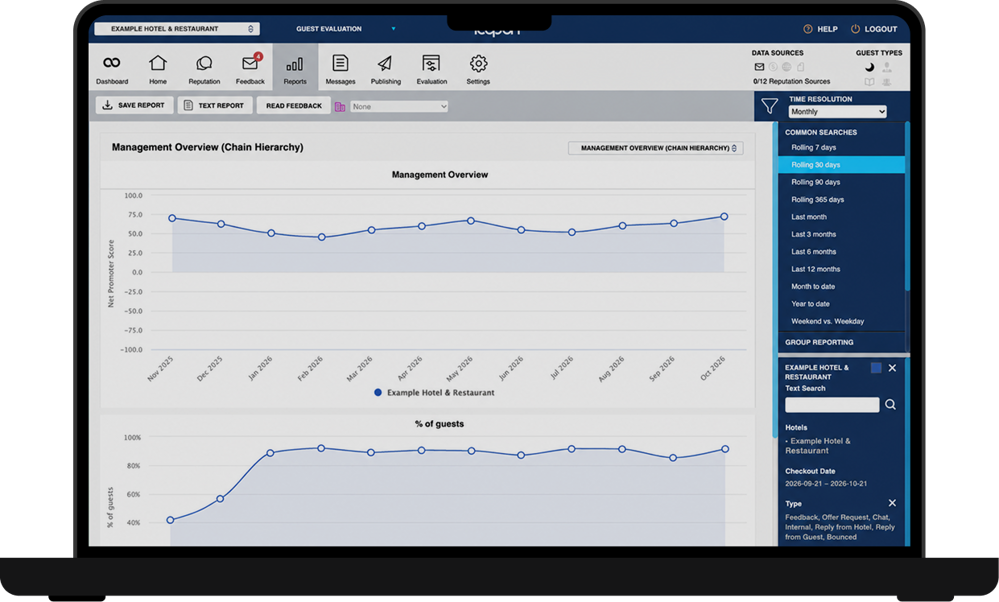
For hotel chains, internal reputation benchmarking also supports comparisons between properties within the same organization.
Identify strengths and improvement opportunities
The purpose of benchmarking is not simply to determine which hotel has the highest score. It is to understand performance differences and use that knowledge to guide improvements.
For example, a hotel may perform well in overall guest satisfaction but fall behind its competitive set in room cleanliness or breakfast experience. By identifying these differences, management can prioritize areas where improvements may have the greatest impact.
Benchmarking can also reveal strengths worth maintaining. Consistently outperforming competitors in service or reception provides useful evidence of what guests appreciate and where the organization has established effective working practices.
By combining benchmarking with guest comments, satisfaction trends and operational reporting, teams can move from performance comparisons to more informed decisions.
Get started with competitive benchmarking
To begin using competitive benchmarking in Loopon, hotels can request a competitive set based on relevant competitors.
The selected hotels must meet Loopon's requirements for participation and data quality. Competitive sets for standardized guest survey results require participating properties to use Loopon and collect sufficient responses for meaningful comparisons.
Once a competitive set has been established, the results become available for comparison within the platform. Hotels can then monitor performance, review differences and follow developments over time.
To request a competitive set or learn more about the requirements, contact the Loopon Support Center at [email protected].
Turn comparisons into better guest experiences
Benchmarking is most valuable when it becomes part of regular performance reviews and improvement processes. Comparing results over time helps hospitality organizations recognize changes, evaluate progress and understand how their guest experience measures up against relevant competitors.
Loopon brings internal performance comparisons, competitive benchmarking and online reputation insights together, providing a more complete foundation for decision-making.
By using benchmarking as an ongoing management tool, hotels can identify successful practices, prioritize improvements and work systematically toward stronger guest satisfaction and loyalty.